Probably Stolen machines: What Each One Makes
Updated
Probably Stolen machines include production, defense, power, and utility machines that make or process items such as water, metal ingots, printed goods, and keycards. The Probably Stolen guide describes 13 machines, including the Furnace, Moisture Collector, and Robot Vacuum. The entries below explain what each named machine does and the conditions stated for its output; names that appear in more than one source are grouped where their described function is the same.
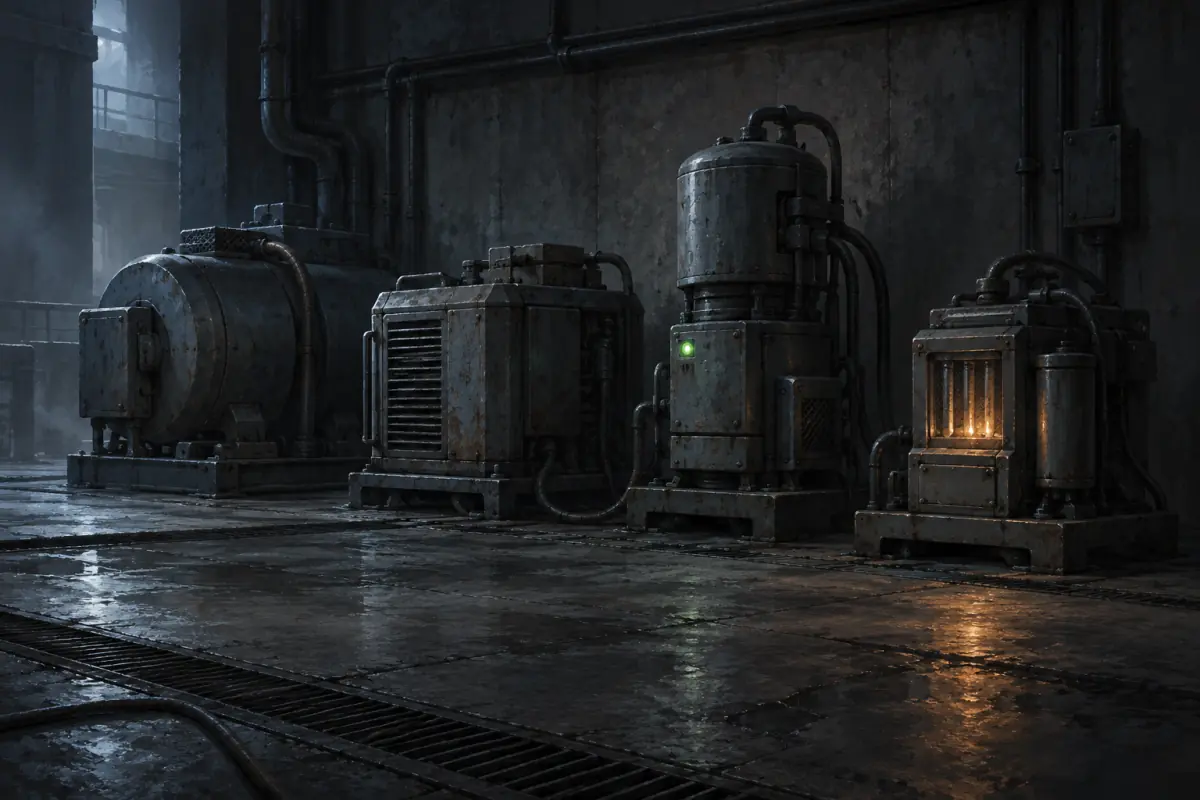
Probably Stolen machine list and output
The Probably Stolen machines list in the table below covers the machine entries named in the cited lists and guides. The guide page describes 13 production, defense, power, and utility machines and adds the Vending Machine in 1.0. Each row gives the base value where the wiki lists one and the job each source describes; a dash means that source gives no value.
The Probably Stolen Wiki fan site, machines and modules collection describes the Hydroponic System, 3D Printer, and Moisture Farm. The Probably Stolen production guide explains how a printing job uses a selected chip, materials, power, and output space. These details make the table useful as a reference for what each machine needs or produces when those conditions are stated.
| Machine | Price or base value | What the sources say it does |
|---|---|---|
| Furnace | 200 | Feed in 2 scrap metal or metal ore while powered; overnight it smelts 1 metal ingot (guide). Refines 2 pieces of metal scrap or ore into a metal ingot (wiki). |
| Moisture Collector | — | Stock a container and power it; produces water overnight, 1,000 ml of Ghost Water per night at baseline. Quality sets the water tier, Performance affects yield (guide). |
| Moisture Farm | 350 | Produces Water when provided with a container; requires Energy; runs overnight. Running several lowers the output of each (wiki). |
| Fridge | — | Chills goods left in overnight: chilled +20%, frozen +25%; wine and unsealed water are unaffected (guide). |
| Bottle Printer | 100 | Prints small bottled water, 4 energy per print (guide). A pre-programmed 3D printer that creates small Water Bottles (wiki). |
| Water Purifier | 250 | Processes an inserted filled container overnight using energy. Performance sets the volume removed; Quality caps what each liquid component it can treat (guide). Purifies an inserted water container using energy; Performance affects removal capacity (wiki). |
| Aging Machine | — | Insert finished fermentation and power; aging settles overnight. Cheese and other qualifying goods work too; counterfeit liquor is rejected (guide). |
| Alarm | — | Sharply cuts the odds of overnight theft; needs a dedicated power source (guide). |
| Charger | — | Recharges energy batteries overnight, provided the electricity service is paid (guide). |
| Recharger | 150 | Slowly recharges an Energy Cell overnight while the power service has been paid (wiki). |
| Energy Array | — | With the electricity service paid, restores 2 charge per night to adjacent batteries; multiple arrays stack (guide). |
| Projector | — | Needs one night to charge, then boosts the shop's street-facing appeal the next day (guide). |
| Feeder | — | Processes usable food into a calorie reserve for your animals (guide). |
| Robot Vacuum | — | Collects droppings at night; upgrading unlocks an incinerator that burns rat droppings on the spot (guide). |
| Decrypter | — | Writes access rights onto blank keycards; the job consumes Decoder Chips, ID cards and energy, and runs all night (guide). |
| Vending Machine | — | Added in 1.0; keeps selling after you close, positioned as nighttime income. Exact earnings go by the live release (guide). |
| 3D Printer | 350 | Prints chip blueprints from supplied materials overnight (wiki). Uses a selected chip, materials, power and output space (production guide). |
| Hydroponic System | 300 | Grows a supplied seed overnight with power and adequate water (wiki). |
| DNA Manipulator | 1000 | Base 12 energy and 10 work per powered night, advancing immediately with Performance and Quality ratios of 2 (wiki). |
| Evaporator | 300 | Evaporates volatile contents overnight; Performance sets throughput, Quality sets recovery (wiki). Processes a mixture into a composition for the Chem Finisher (production guide). |
| Auto Butcher | 400 | Processes animals or fish under configured weight, age and breeding quotas; marked or custom-named creatures are protected (wiki). |
| Cryptographic Desequencer | 350 | Requires a Desequencer Chip and an Access Keycard, plus energy, overnight (wiki). Turns a keycard and chipset into a disposable keycard of the chipset's type (Steam guide). |
| Recirculating Aquaculture System | 300 | A closed-loop fish system that needs its fixed reservoir, a battery, filters and feed (wiki). |
| Heating Plate | 250 | Heats chemical mixtures; chemical-device modules unlock higher temperatures and faster heating (wiki). |
| Blender | 200 | Blends eligible ingredients into a liquid container (wiki). |
| Chem Finisher | 300 | Packages a prepared mixture into a selected pill or vial recipe; it does not purify the active ingredient by itself (wiki). |
| Wine Ager | — | Ages wine an extra day each night (machines guide on probablystolen.net). |
| Cleaner Robot | 250 cr (production guide) | A cage-cleaning support device; check its battery and operating mode (production guide). |
| Storage Coordinator | 400 | Assigns containers and machines to presets; each preset can have a hotkey (wiki). |
Probably Stolen production machines and their conditions
Probably Stolen production machines do not all work in the same way: some need power, some need inputs, and some process goods overnight. The Furnace needs power to smelt scrap metal or metal ore into ingots overnight. The Hydroponic System needs a supplied seed, power, and enough water before it can grow that seed overnight. These stated requirements help connect a machine's output to the materials and conditions listed for it.
The Moisture Collector's description ties its water output to two separate settings: Quality sets its tier, while Performance affects its yield. The Moisture Farm is described as producing water when given a container and energy. A game systems guide gives Moisture Farm yields of 850 mL with no Performance bonus, 1,700 mL at +100, and none at −100; those figures apply to that source's Moisture Farm description, not to every water machine.
The 3D Printer makes the product specified by its printing job. Its listed inputs are a selected chip and materials, and it also needs power and space for the output. The Machines and Modules collection describes it as printing chip blueprints from supplied materials overnight. Together, those descriptions identify both the job's role and the basic resources the printer uses, without specifying a price or a complete recipe for each possible item.
The bottle and chemistry machines cover different stages of production. The Bottle Printer uses power to make water containers, with a machine guide listing 450ml, 750ml, and 2l containers. The Evaporator processes a mixture overnight into a composition for the Chem Finisher, which turns a suitable mixture into the selected finished product. The available descriptions explain that sequence but do not list material recipes or machine costs.
Overnight utility, sales, and animal machines
The Robot Vacuum and Vending Machine have overnight roles that do not match the ingredient-processing machines. The Robot Vacuum collects droppings at night, and another machine guide says a vacuum robot stores animal feces overnight. The Vending Machine continues selling goods after the shop closes, according to a machine guide and a guide to the full release. Those descriptions identify collection and sales as their stated tasks.
The Wine Ager adds an extra day of aging to wine each night. That output is a change to the wine's aging, rather than a newly named material or container. The source descriptions do not give a capacity or a particular finished wine result, so the useful takeaway is the overnight aging function itself.
The Fish Tank raises fish such as tilapia, and the described growth sequence runs from roe to fry to adults. That gives the machine a clear production role based on raising fish over stages. The description does not state a time per stage or a yield, so this page lists only the fish raising and reproduction details that are given.
The Water Purifier handles water that already exists, converting contaminants into cleaner water. A guide also describes moisture collectors and purifiers as producing tested, filtered water for sale, while a separate systems guide identifies the Moisture Farm as producing source water. Read together, those entries describe water production and cleaning as distinct machine functions; they do not provide a shared price or a full set of water recipes.
Our take on Probably Stolen machines
The Probably Stolen machines descriptions show several practical production patterns: gather an input, provide power or another requirement, and let a machine process it overnight. The Furnace, Hydroponic System, 3D Printer, and Evaporator each have an overnight process described, while the Vending Machine continues sales after closing and the Wine Ager adds an aging day overnight. Those are concrete tasks a player can use to distinguish the machines without assuming that every machine follows the same schedule.
The clearest machine choices depend on the output needed. Metal ingots come from the Furnace, water comes from the Moisture Collector or Moisture Farm, and the Water Purifier makes contaminated water cleaner. The printer, bottle maker, finisher, and desequencer each produce a specified kind of item or result, while the Robot Vacuum and Fish Tank collect or raise animal-related goods. This grouping follows the stated outputs and does not assign extra costs or performance ratings.
The sources give more operating detail for some entries than for others. The Moisture Collector has Quality and Performance conditions, the Farm has three Performance yield examples in one guide, and the 3D Printer has stated input and space requirements. Other entries are described by their basic output or overnight task. A player comparing Probably Stolen machines can therefore use the table to identify the job first, then check the relevant in-game conditions for the machine they plan to use.
Frequently asked questions
How many Probably Stolen machines are listed?
The guide page describes 13 production, defense, power, and utility machines, and 1.0 adds the Vending Machine. The table lists the machine entries named in the cited lists and guides; modules and upgrades are left out of this page.
What does the Furnace make in Probably Stolen?
The Furnace turns scrap metal or metal ore into metal ingots, and its guide description says it does this overnight while powered. Another source describes the conversion as using two materials to make one ingot overnight, but does not give a cost for buying the Furnace.
What does the Moisture Farm make, and how much water does it produce?
The Moisture Farm produces water when supplied with a container and energy. One systems guide lists 850 mL with no Performance bonus, 1,700 mL at +100, and no water at −100; the Moisture Collector's tier and yield are described separately through Quality and Performance.
What do Probably Stolen production machines need to run?
The requirements depend on the machine: the Furnace needs power, the Hydroponic System needs a seed, power, and enough water, and the 3D Printer needs a selected chip, materials, power, and output space. The Moisture Farm needs a container and energy, while the Evaporator processes a mixture overnight.
Which Probably Stolen machines work overnight?
The Furnace smelts materials overnight, the Hydroponic System grows a supplied seed overnight, and the Evaporator processes a mixture overnight. The Vending Machine sells goods after the shop closes, the Wine Ager adds an aging day each night, and the Robot Vacuum collects droppings at night.
What does the Bottle Printer make?
The Bottle Printer uses power to produce water containers. A machine guide names 450ml, 750ml, and 2l sizes, while another guide describes bottled products including larger bottles at higher tiers.
Sources
- Machines Guide: All 13 Machines Rated | Probably Stolen
- Machines & modules · Probably Stolen Wiki
- Probably Stolen Machines, Power & Winemaking Wiki
- Steam Community :: Guide :: Machinery and You [Missing 1.0 info]
- Probably Stolen Machines Guide: Modules, Furnace & Power
- Machines & production
- Probably Stolen Machines and Upgrades Priority Guide: What to Build First in the Demo - Vaagame